- For SME and Groups
- For Individuals
Group Health Insurance
About Cigna Healthcare
Why Employee Wellbeing Matters
Why Employee Wellbeing Matters: How Companies Should Leverage this for Talent Retention and Employer Branding

Once a ‘nice-to-have’, employee wellbeing has evolved into a corporate necessity for organisations who want to stay relevant in 2026 and beyond. This was one of the key discussion points which emerged at our inaugural HR Connect Forum, where we brought together key HR and decision makers across various organisations and industries.
Wellbeing benefits that matter to your employees are a strategic lever that play a key role in talent attraction and retention, increasing productivity, enhancing employer branding and ultimately leading to better business performance.
For organisations who want to – and should – invest more in employee wellbeing, these are key highlights you should keep in mind.
Wellbeing is no longer optional
Employee expectations have changed, particularly after the Covid-19 pandemic. Prospective employees are no longer asking whether they have healthcare coverage. They want to know what kind of care they can access and how quickly, plan benefits and design, and whether this support is relevant to their stage of life.
Having robust and relevant benefits can be a key differentiator for your company, against other competitors – and this has a big impact on talent attraction and retention. Beyond that, investing in wellbeing has a tangible pay-off for organisations as well, and shouldn’t be written off as costs only.
According to the Cigna Healthcare International Health Study 2025, 79% of employees in Singapore are stressed; and 48% experience disrupted sleep as a result. This can have tremendous impact on one’s physical and mental health, particularly if left unmanaged.
Absenteeism is a key effect. 36% of employees miss a part of their workday due to their health, and 31% accomplish less at work due to mental health challenges.
As such, investing in workforce health can deliver measurable productivity and performance, which will ladder up to longer term organisational benefits.
From ‘one-size-fits-all’ to stratified benefits that embraces “Total Health”
Health is deeply personal – and it follows that benefits need to be tailored, for them to be relevant and useful for your employees to support total health or whole person health. For example: a 27-year-old employee may find gym access and mental health resources more relevant to their life stage; while a 55-year-old employee may want more support with managing chronic conditions.
For employers, the goal isn’t simply to introduce more benefits – for this can create downstream issues of utilisation and costs. Rather, it’s about creating the right mix of benefits that are relevant and useful for your employees based on their needs.
One way of guiding benefit design can be to look at this simple matrix, balancing:
- Demographic & Life-stage: Different groups would require different care journeys. Even within gender, different ages may require different resources, such as younger women vs women going through (peri)menopause.
- Level-of-care: Encouraging preventive care is a good start, along with strengthening primary and acute care access as these can ensure early intervention for conditions. Secondary care and chronic care management should also be supplemented, depending on what is required by your employees.
This is easier said than done. The growing challenge one faces is balancing (1) timely access to quality care, (2) ensuring their employees are delivered the best clinical outcomes, (3) while maintaining financial sustainability to ensure long-term coverage remains viable.
Strong partnerships between employer and insurer can help, and companies should leverage on the expertise of their insurance partners when structuring their benefits. At Cigna Healthcare Singapore, we take pride in working closely with our clients to design modular plans and benefits that work for both the company and the employee.
Encourage utilisation through education and culture
One common source of frustration is: Offering benefits with good intention but with low usage by the employees.
Often, this requires equipping employees with literacy around their benefits as well as ensuring that wellness is embedded in one’s organisational culture; such that employees know what they can access and feel safe doing so as well, without stigma or repercussions on their careers.
In the case of mental health benefits, there could still be a stigma around accessing help for one’s stress or mental wellbeing. In the same International Health Study, 77% of respondents believe they do not need therapy; with the highest percentage coming from individuals aged 45 and older, while for the younger generation, though they are more open, access and cost is prohibiting them from doing so. This implies a generational difference in the perception around seeking help.
Cultivating a workplace culture that embraces total health is key, to make help-seeking non-taboo. This means normalising conversations around mental health; as well as having senior leaders visibly embrace mental wellbeing so it becomes acceptable to be vulnerable.
There may also be a lack of knowledge around the types of resources available to employees, and how to utilise these resources. For example, educating employees on the differences between counselling offered via an Employee Assistance Programme (EAP) and seeking help from a psychologist; and the expected outcomes of these different mental health touchpoints. Improving health literacy ensures that employees know where they should seek help, when they need it – and the effectiveness of the intervention, when they do utilise it.
Communication is the key to building a future workforce
Many organisations are now managing four (or even five) generations of employees concurrently. That reality shows up in two places: benefit expectations and day-to-day management.
Younger employees may have a different mindset when it comes to work, compared to the generations before them – and this may cause friction in working styles or expectations at the start.
However, if we want to create a future-ready and truly inclusive culture, leaders must learn how to bridge the gap. This starts with stopping the default to ‘In my day…’ narratives or assuming that one’s way of working is the best.
Bridging the gap takes deliberate communication, listening, and sometimes new mechanisms, like pairing managers with a younger “proxy” leader who can help translate expectations, or practicing reverse mentoring so senior leaders can also learn how the younger talent force think and why they act a certain way.
Rather than hold strictly to what has been done before, leaders should create enough flexibility to meet people where they are; balanced with clarity on accountability and focused outcomes.
What HR Leaders can do in the next 6 – 12 months
There is still a lot of work that can and should be done. These are a few actionable steps leaders can take:
- Segment your benefits and wellness program with intent: Take a look at your existing benefits and employee wellness program to see if they address the needs of your employees, considering key groups (life stage, demographics, level of care needs) instead of a one-size fits all approach.
- Invest in adoption, not just availability: Reduce stigma, make seeking-help normal, and test whether existing resources are accessible and useful. For example, at Cigna healthcare, we partner with our clients to conduct wellness literacy workshops through our in-house clinical care team and providers.
- Equip managers as the frontline of culture: Managers shape psychological safety, boundaries, and day-to-day wellbeing more than posters and handbooks ever will. Equip them with resources and knowledge in effective communication and management skills that addresses different generations of employees.
Ultimately, wellness is a strategic investment and needs intentional effort. Employee wellbeing requires sustained resources and cultivation – but it is essential.
To ensure that you uphold your brand with a workforce culture where employees can thrive while keeping healthcare costs manageable so you can attract and retain the right talent, it is more important than ever that organisations start now.
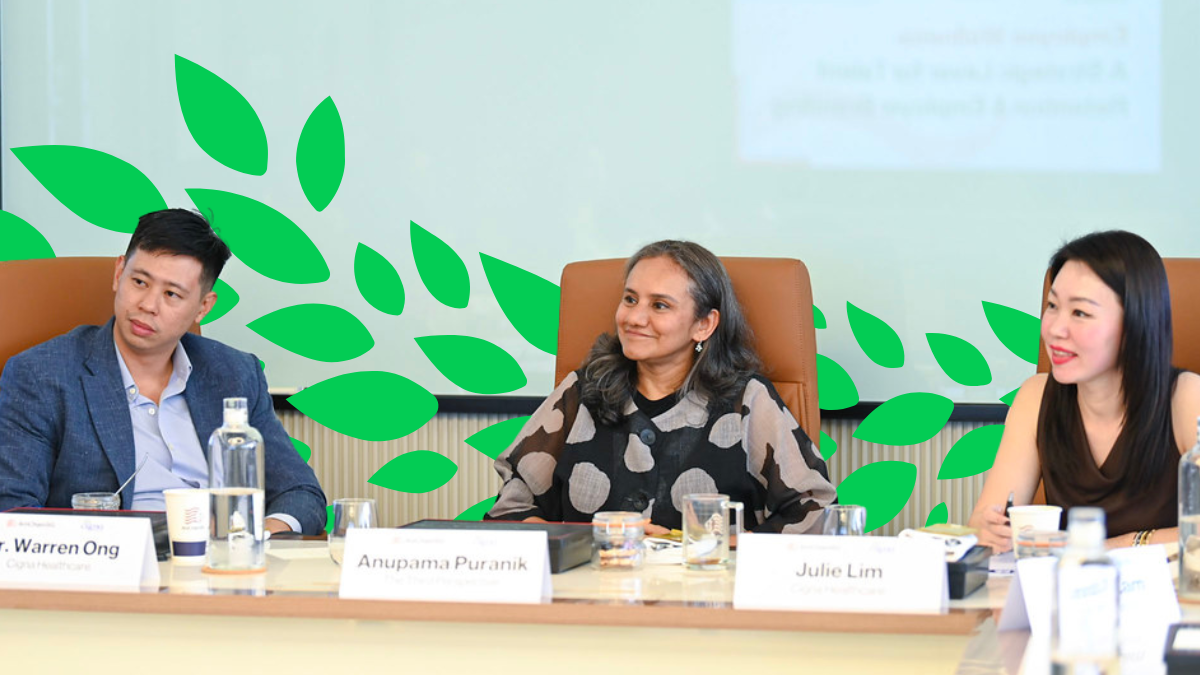
The HR Connect Forum is a forum hosted by Cigna Healthcare Singapore. Our inaugural session was held together with The American Chamber of Commerce in Singapore (AmCham); with panel speakers Dr Warren Ong, Medical Director, Cigna Healthcare Singapore, APAC, Anupama Puranik, Board Governor and Board Liaison Human Capital Committee, AmCham, and moderated by Julie Lim, Key Account and Broker Relations Director, Cigna Healthcare APAC.
If you would like to join a future session, you can join our mailing list to get the latest updates on upcoming events.
Get a Quote Today
Speak to our consultants about your healthcare, wellness and wellbeing needs today and let us design the right health insurance plan for your business.

Related articles
© Cigna Healthcare. All rights reserved.
Cigna Europe Insurance Company S.A.-N.V. Singapore Branch (Registration Number: T10FC0145E), is a foreign branch of Cigna Europe Insurance Company S.A.-N.V., registered in Belgium with limited liability, with its registered office at 152 Beach Road, #33-05/06 The Gateway East, Singapore 189721.
The Cigna Healthcare name, logo, and other Cigna Healthcare marks are owned by The Cigna Group Intellectual Property, Inc. licensed for use by Cigna Corporation and its operating subsidiaries. All products and services are provided by or through such operating subsidiaries, and not by Cigna Corporation. Such operating subsidiaries include Cigna Europe Insurance Company S.A.-N.V. Singapore Branch.
