- For SME and Groups
- For Individuals
Group Health Insurance
About Cigna Healthcare
Connecting the Dots for Sustainable Employee Healthcare: A Data-Driven Approach
Connecting the Dots for Sustainable Employee Healthcare: A Data-Driven Approach

From common healthcare conditions to the costs of treatment, everything in the healthcare ecosystem is inter-connected. What matters is how employers and insurance partners like Cigna Healthcare Singapore connect these dots to deliver sustainable, reliable healthcare for employees.
Dr Warren Ong, Head of Medical, Cigna Healthcare, APAC, shares his thoughts on how data can be the connecting dots linking targeted healthcare programmes to members who need them most.
This is especially crucial for employers and insurers amidst rising healthcare premiums alongside employee expectations for health and well-being support. Data-driven healthcare interventions can be more impactful and effective than general ones.
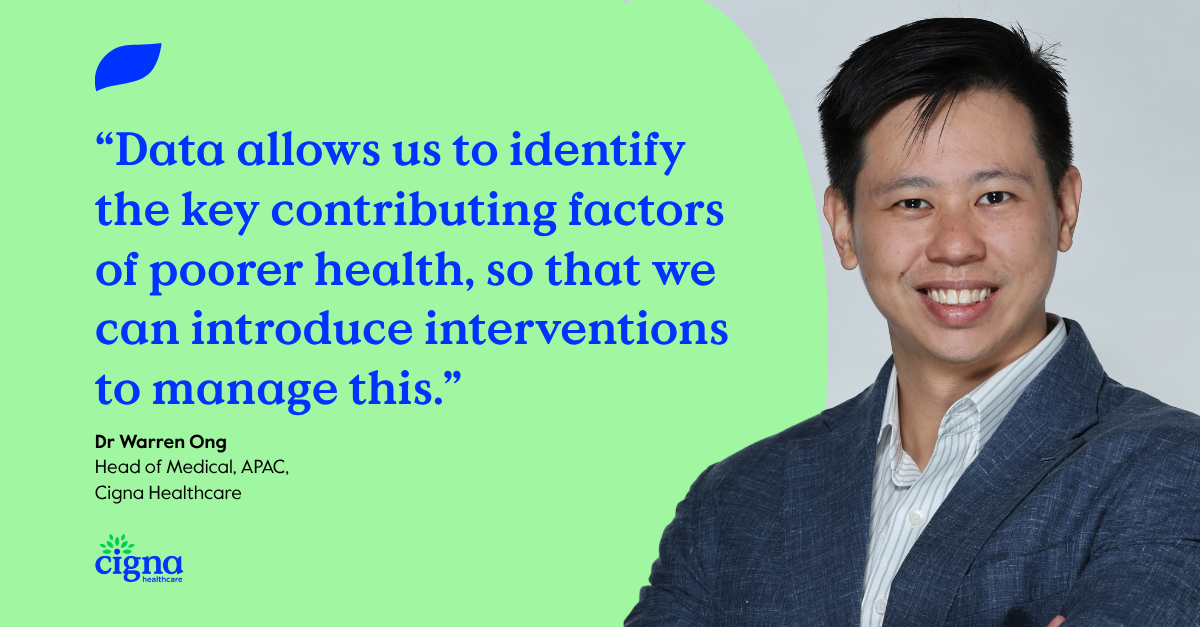
“There are various reasons for premium rises: a sustained increase in claims frequency; higher utilisation of healthcare services due to earlier detection; or a rise in complex treatments. Data allows us to identify the key contributing factors, and thus, introduce programmes and interventions to manage this.” -- Dr Warren Ong, Head of Medical, APAC
Identifying the Drivers of Healthcare Spend
Think of each data point as a single dot – alone, it may not show much; but many dots on a blank canvas form a vivid painting. Similarly, robust healthcare data allows us a deeper understanding of a population’s health. More importantly, it reveals what more we can do to support their well-being.
Healthcare data often reveals that a relatively small number of conditions account for a disproportionate share of claims costs. This enables insurers like us to pin-point the key drivers of healthcare spend and where resources are currently being directed towards.
For example, from our claims data, we see that:
- Musculoskeletal (MSK) conditions are the top driver of claims volume and claims spending across members; with back pain being the most common source of MSK issues.
- Respiratory conditions, such as influenza, are amongst the top 5 conditions that contribute to claims volume and claims spending.
- Neoplasm treatment, such as for malignancies and benign tumours, is the second top driver of claims spending.
- Our role as health insurers is to link these disparate dots of data points into a full picture of your employees’ health, giving our clients actionable insights for their organisations. Once we are able to identify key health concerns, we can design targeted interventions that address these issues more effectively.
Done well, data-driven analysis can help employers to better manage higher claims volume, reduce the severity of healthcare conditions, and lower downstream healthcare spending over time.
Data-driven Interventions for Preventative Health
As our data shows, most of healthcare spend and claims are due to preventable conditions. On an employee population level, introducing general programmes like a flu vaccination drive or better office ergonomics can help employees to better manage these health conditions, reducing the incidence of ill health later.
More importantly, with robust data drawing the connection, we can link employees with health and well-being programmes that benefit them the most. Employers no longer need to take a one-size-fits-all approach to their workplace health. Data enables a deeper understanding of emerging health issues for different demographic groups; and this allows targeted interventions.
For example, our claims data highlight that chronic conditions are a cause of concern for male employees, particularly seniors. Workplaces with a higher proportion of older men could then consider introducing physical activity programmes that would appeal more to this demographic to help shift behaviours towards the healthier.
In this way, data are the connecting dots between employee and intervention. It enables employers to be more strategic about the workplace wellbeing programmes they introduce, to improve the uptake of these initiatives and programmes by the employees they are targeting.
Ultimately, this data-driven decision making will help to reduce downstream healthcare spending; while also improving employee experience.
Improving Care Navigation
Lastly, healthcare data allows us to see what employees are spending on and whether this spend is cost-efficient. A significant contributor to healthcare expenditure is over-servicing, which occurs when employees are unsure about their available healthcare options.
Through looking at claims data, we can understand if employees require more support with their healthcare decisions, such as clinical guidance around the types of treatments that are appropriate for their conditions.
Cigna Healthcare’s Clinical Case Management programme is an example of better care navigation for our members; and is a key component of our Cigna Prime and Cigna Care Connect 2.0 plans.
Leveraging their clinical expertise, our Clinical Case Managers help members better understand their treatment options. This includes supporting members in exploring alternative treatment approaches, understanding day surgery options versus prolonged inpatient stays that have its own risks, seeking second opinions when appropriate, and identifying appropriate healthcare providers for their specific needs.
The focus is not removing choice for members, but rather, ensuring they have all the information to make an informed decision about their healthcare treatments. Through these guided pathways and member education, we empower members to take charge of their health, based on quality, value, and cost-effectiveness.
What does Sustainable Healthcare look like?
As healthcare needs continue to evolve, employers will need benefit strategies that are people-centred and economically sustainable.
This can only be driven by a data-backed understanding of your organisation’s health – with data points connecting the dots between your employees, their healthcare challenges, and the interventions that would suit them best.
A trusted health partner, like Cigna Healthcare, can be crucial to the success of your workplace health strategies. If you would like to find out more about our work and corporate healthcare plans, do reach out on how we can collaborate on your organisation’s health.
Related articles
© Cigna Healthcare. All rights reserved.
Cigna Europe Insurance Company S.A.-N.V. Singapore Branch (Registration Number: T10FC0145E), is a foreign branch of Cigna Europe Insurance Company S.A.-N.V., registered in Belgium with limited liability, with its registered office at 152 Beach Road, #33-05/06 The Gateway East, Singapore 189721.
The Cigna Healthcare name, logo, and other Cigna Healthcare marks are owned by The Cigna Group Intellectual Property, Inc. licensed for use by Cigna Corporation and its operating subsidiaries. All products and services are provided by or through such operating subsidiaries, and not by Cigna Corporation. Such operating subsidiaries include Cigna Europe Insurance Company S.A.-N.V. Singapore Branch.
